
Virtual Assistant vs. AI for WooCommerce: Which One Does Your Store Really Need?
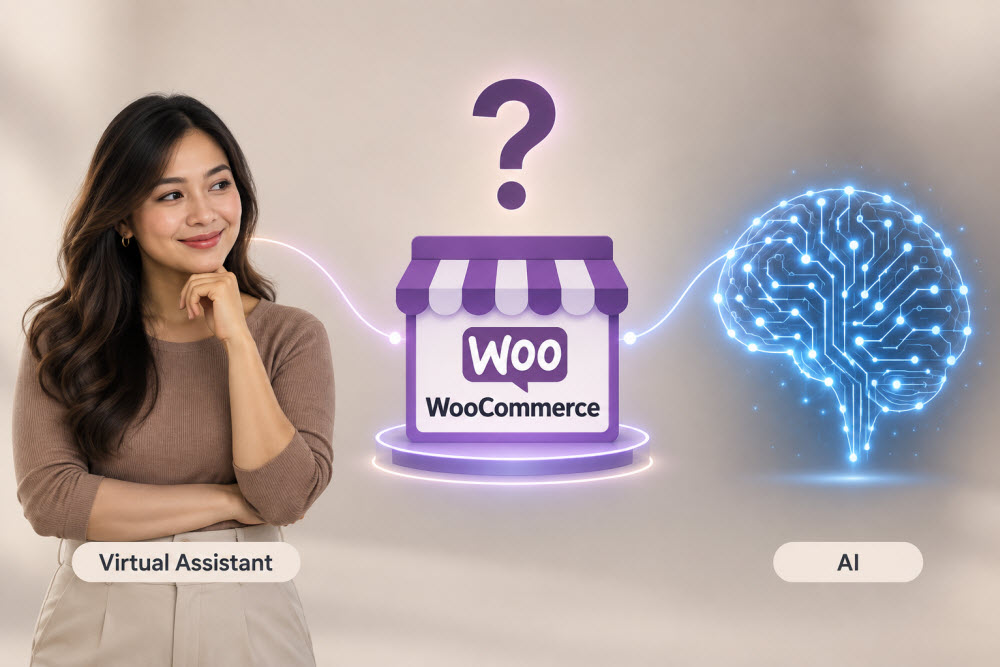
Artificial intelligence can draft a product description in seconds. It can organize ideas, summarize information, and help turn a rough instruction into usable content. With abilities like these, a WooCommerce store owner may wonder: Do I still need a virtual assistant, or can AI manage the work instead?
The honest answer is that AI and a WooCommerce virtual assistant are not interchangeable.
AI is a tool that can accelerate certain tasks. A skilled virtual assistant is a person who understands instructions, reviews details, notices problems, communicates with the store owner, and takes responsibility for completing approved work correctly. In many stores, the strongest system is not VA versus AI. It is a capable VA using AI carefully, with human judgment at every important step.
This guide explains what each can do, where each falls short, and how store owners can combine them without sacrificing accuracy, customer trust, or security.
What Is a WooCommerce Virtual Assistant?
A WooCommerce virtual assistant is a remote professional who supports the day-to-day operation of an online store built with WordPress and WooCommerce.
Depending on the role, a WooCommerce VA may add products, update inventory information, format descriptions, prepare images, check orders, publish promotions, respond to customer questions, produce reports, or test store pages. The official WooCommerce documentation shows how much detail product management can involve, including product types, prices, stock, SKUs, dimensions, images, attributes, and variations. WooCommerce product documentation
A VA does not necessarily control every part of the store. Payment settings, taxes, refunds, security, code changes, and large bulk updates may require owner approval or a qualified specialist. A well-defined scope is essential.
What Does “AI for WooCommerce” Mean?
AI for WooCommerce can refer to generative assistants, features built into store tools, or outside applications connected to a workflow. They may create text, summarize information, categorize data, or suggest replies.
AI is especially useful when the task has:
- A clear instruction
- Reliable source information
- A repeatable format
- A human reviewer
- A low cost of correcting mistakes
However, AI does not automatically know the store owner’s current inventory, policies, supplier information, customer history, or business priorities. It only works with the information and access available to it—and even then, its output can be incomplete or incorrect.
WooCommerce Tasks AI Can Help With
Drafting Product Descriptions
AI can turn approved product facts into a first draft, suggest benefit-focused language, or create alternative versions for different audiences. This can save time when a store has many similar products.
AI should never invent dimensions, materials, warranties, compatibility, ingredients, safety claims, or results. Compare every draft with approved product details before publication.
Creating SEO Starting Points
AI can suggest product titles, meta descriptions, category introductions, alt-text drafts, and keyword themes. Review them for search intent, natural language, duplication, accuracy, and length. AI output does not guarantee rankings.
Rewriting and Formatting Content
AI can shorten copy, change the tone, convert notes into bullet points, or arrange details into a template. A VA must ensure that the revision preserves the original meaning.
Drafting Customer-Service Replies
AI can help prepare polite responses for common questions about delivery, order status, product care, or return procedures. The VA must verify the reply against the store’s real policies and the customer’s situation before sending it.
Summarizing Reports and Reviews
AI may help summarize exported store data or customer feedback. WooCommerce Analytics currently provides reports, filters, comparisons, dashboards, and CSV downloads. A person still needs to interpret whether the data is complete and what it means. WooCommerce Analytics documentation
Generating Ideas
AI can suggest seasonal campaign themes, product bundles, FAQs, email topics, or social media angles. Treat these as ideas for evaluation—not instructions that should be published or implemented automatically.
WooCommerce Tasks That Need Human Judgment
Verifying Product Information
One incorrect digit in a price, SKU, size, or stock quantity can create a problem. A VA can compare sources, identify missing information, and ask before assuming.
Managing Exceptions
Store work is rarely perfectly repetitive. A variation may lack an image, a coupon may fail, or an order may contain conflicting notes. A person can gather context and decide when to escalate.
Handling Orders and Customer Information
WooCommerce order management can involve statuses, customer details, totals, notes, refunds, invoices, privacy measures, and troubleshooting. Its documentation states that orders are available to Administrator and Shop Manager roles, showing why access must be intentional rather than casually shared. WooCommerce order-management documentation
A trained VA can follow an approved procedure and recognize when a request requires the store owner. AI should not independently make decisions about refunds, disputes, or unusual orders.
Protecting Brand Voice and Customer Trust
Customers notice when descriptions sound generic or replies ignore their actual concern. A VA can adjust communication to match the brand, remove awkward language, and ensure that a customer receives a useful answer rather than a polished but irrelevant one.
Performing Visual Quality Assurance
Even correct text can appear beside a stretched image, broken button, missing variation, or poor mobile layout. A VA can inspect the real customer experience.
Taking Responsibility
AI can produce an output, but it cannot own a deadline, clarify a confusing instruction with the client, or accept responsibility for an incorrect live-store change. A VA provides communication and accountability around the work.
Where AI Can Go Wrong
It Can Invent Plausible Details
Language models can produce confident statements that are not supported by the source material. OpenAI explains that hallucinations remain a fundamental challenge for language models, reinforcing the need to verify factual output. OpenAI: Why language models hallucinate
In WooCommerce, an invented product feature or policy is not a harmless writing mistake. It can mislead a customer.
It May Miss Context
AI may not know that a product is being discontinued, a client prefers a particular format, a promotion has changed, or a customer has already contacted support three times. A human reviewer can connect those details.
It Can Produce Repetitive Content
Without careful prompting and editing, descriptions may use the same structure, adjectives, and claims. A VA can compare pages across the catalog and improve variety without changing product facts.
Sensitive Data Can Be Exposed
Customer names, addresses, order details, passwords, and confidential business information should not be pasted into an AI service without authorization and an understanding of the tool’s data practices. Use anonymized information whenever possible and follow the client’s security policy.
Automation Can Multiply Errors
An incorrect draft affects one item. An unchecked automated workflow can apply the same mistake to hundreds of products. The more powerful the automation, the more important testing, approval, and rollback planning become.
WooCommerce VA vs. AI: A Practical Comparison
| Need | AI | WooCommerce VA |
|---|---|---|
| Create a first draft quickly | Strong | Can do it, usually more slowly |
| Verify product facts | Cannot be trusted without sources and review | Can compare details and ask questions |
| Follow store-specific procedures | Only when properly instructed | Can learn, document, and apply them |
| Handle unusual customer situations | Limited by available context | Can investigate and escalate |
| Check page appearance and usability | Limited unless specifically equipped and directed | Can review the live customer experience |
| Protect confidential information | Depends on tool settings and user behavior | Depends on training, access, and professional practice |
| Communicate with the store owner | Can generate messages | Can understand replies and adjust the work |
| Take responsibility for completion | No | Yes, within the agreed role |
| Work repeatedly at speed | Strong | Stronger when supported by good systems and AI |
When a Store May Benefit Most From AI
AI may be sufficient for an owner with a small catalog who only needs occasional help drafting low-risk content. It works best when the owner can provide accurate sources, write clear instructions, review every result, and implement the final work. If review and publishing become additional unfinished tasks, AI has not solved the workload problem.
When a Store May Need a Virtual Assistant
A WooCommerce VA becomes valuable when the store has recurring operational work that needs a dependable person. Signs include:
- Product updates are delayed
- Catalog details are inconsistent
- Customer questions wait too long
- Promotions are not published on schedule
- The owner lacks time for routine checks
- Reports are available but rarely reviewed
- AI drafts exist but still need editing and publishing
The VA does not replace the owner’s authority, but provides execution, communication, and quality control.
The Better Model: A WooCommerce VA Using AI
The most practical approach often combines human ownership with controlled AI assistance. For example, a client provides an approved product spreadsheet and brand guide. The VA checks the source data, uses AI for first drafts, verifies every claim, edits the wording, enters the products, adds media and metadata, reviews variations, and tests the pages.
In that workflow:
- The client supplies authority and accurate business information.
- AI accelerates drafting and repetitive transformations.
- The VA provides judgment, execution, quality assurance, and communication.
This is not automatic store management. It is a supervised workflow using each resource for what it does best.
A Safe AI-Assisted WooCommerce Workflow
- Define the task. State what AI may assist with and what requires human approval.
- Prepare verified source data. Do not ask AI to fill gaps with guesses.
- Protect sensitive information. Remove personal or confidential data unless the client has approved its use in that tool.
- Generate a limited sample. Test one or two products before processing a large catalog.
- Review facts line by line. Compare output with the approved source.
- Edit for the brand and customer. Remove generic language and improve usefulness.
- Enter or import carefully. Confirm field mapping, variations, prices, and stock details.
- Check the customer-facing page. Review desktop and mobile displays, links, images, and purchasing options.
- Obtain approval when required. Do not publish sensitive or high-impact changes without authorization.
- Document the work. Record what was changed, which content used AI assistance, and any issues found.
What Store Owners Should Look for in an AI-Savvy WooCommerce VA
Look beyond whether a candidate has used a popular AI platform. A strong VA should be able to:
- Explain how they verify AI-generated content
- Recognize which store tasks should not be automated
- Follow brand, product, and customer-service guidelines
- Protect customer and business information
- Test a small sample before a bulk change
- Document their process
- Escalate exceptions instead of guessing
The valuable skill is not merely prompting AI. It is knowing how to turn assisted output into accurate, approved store work.
Common Mistakes to Avoid
Publishing AI content without checking it
Every product fact and policy statement needs verification.
Giving AI unnecessary customer data
Use the minimum information required and follow the store’s security rules.
Automating a process before testing it manually
Understand the workflow first, then test automation on a small, reversible sample.
Expecting a VA to repair every technical problem
Define when the VA should stop and escalate to a developer, security professional, accountant, or other qualified specialist.
Choosing between people and tools as if only one can exist
AI can increase a VA’s efficiency, while a VA supplies the judgment and accountability AI lacks.
Frequently Asked Questions
Here are clear answers to some of the most common questions readers have about this topic.
Can AI completely replace a WooCommerce virtual assistant?
Not for work that requires ongoing judgment, client communication, exception handling, visual review, and accountability. AI can assist with parts of the workflow, but a person must still verify and approve important outputs.
What WooCommerce tasks are safest to assist with using AI?
Lower-risk uses include brainstorming, drafting from verified product facts, rewriting supplied content, creating templates, and summarizing non-sensitive information. All output should be reviewed before publication.
Can a WooCommerce VA use ChatGPT or another AI tool?
Yes, when the client permits it and the VA follows the client’s security, privacy, and review requirements. Sensitive information should not be entered casually into any outside tool.
Is AI-generated product content good for SEO?
It can provide a starting point, but usefulness, accuracy, originality, search intent, and editing matter more than how quickly the text was generated. Avoid publishing repetitive drafts simply to create more pages.
Should a beginner VA learn AI or WooCommerce first?
Learn the WooCommerce task first so you understand the fields, risks, and desired result. Then use AI to assist parts of the process. Automation is safer when you can recognize an incorrect output.
Key Takeaways
Before you close this page, here are the most important lessons to carry with you:
- AI can accelerate WooCommerce drafting, formatting, summaries, and idea generation.
- A WooCommerce VA adds verification, judgment, communication, execution, and accountability.
- Product facts, customer messages, orders, and live-store changes require careful human review.
- AI should not receive sensitive store or customer data without authorization and suitable safeguards.
- The strongest approach is often a trained VA using AI within a documented, supervised workflow.
“Technology can help the work move faster, but thoughtful human care is what keeps every product, promise, and customer interaction worthy of trust.”
Final Thoughts
A store does not need to reject AI to value human support, and it does not need to avoid hiring a VA to benefit from automation. These resources solve different parts of the problem.
Use AI for speed where the source information is reliable and the task can be reviewed. Use a WooCommerce virtual assistant when the work requires context, judgment, consistency, communication, and follow-through. Combine them when recurring store tasks would benefit from both efficiency and human responsibility.
The real question is not simply, “Should I choose a VA or AI?” It is, “Who will make sure the final work is accurate, secure, approved, and genuinely helpful to the customer?”